
Last updated: September 2026
Your rug is the wear part in the room
An area rug takes the grinding so the floor under it does not. That is hard work, because the dirt tracked in on shoes carries grit with edges sharp enough to cut a wool pile as well as stain it. We clean every one of them flat on your own floor, whatever the fiber, and it is dry again inside the hour.
- Dry first, wet second. Water on loose grit makes slurry and drives it toward the backing.
- Half turn every six months, so the sun end and the walked-on end trade places.
- Fringe takes the wear first, so keep the vacuum's spinning brush away from it.
- Moths eat wool and silk, and only where nobody walks. Move the furniture twice a year.
What is actually grinding your rug down
Most rugs do not die of spills. They die of grit, and a rug is exactly where grit collects, because it lies in a doorway or in front of a sofa and takes the same few steps over and over on one small piece of floor. Wall-to-wall carpet spreads that load across a whole room. A 5x7 has nowhere to spread it.
The damage shows up as color first. A lane goes pale before it goes thin, because a scratched surface turns dull long before it goes bald, and owners read the paleness as faded dye and stop bothering. By the time the pile feels low there the loss is mechanical, and no cleaning brings it back. What is doing the scratching is tracked-in grit, and our dirt and grit guide covers where it comes from and what it does.
A rug gets a long dry pass before anything wet goes near it. Grit that gets wet first turns to slurry and rides down to the foundation, where it lodges and keeps working. That matters twice over on a rug, because the foundation is the part everything else hangs on.
Reading the back of the rug
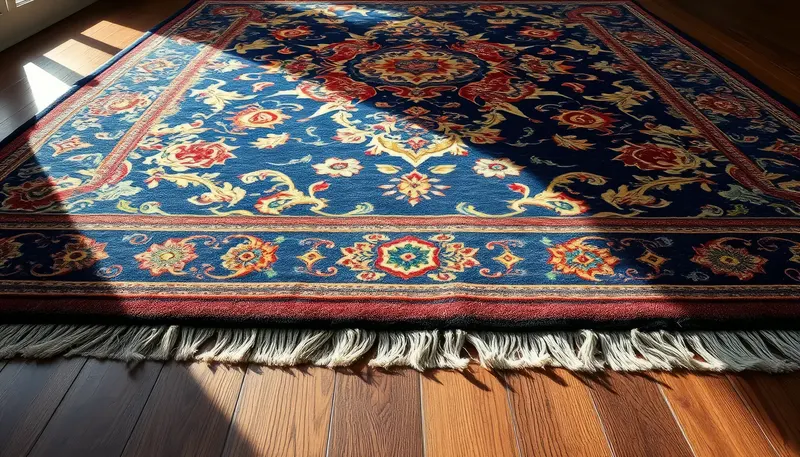
Turn a corner over before you decide how to treat anything. Knots you can count, with the pattern showing through in rows, mean somebody tied this rug by hand. A printed grid means a machine made it. A cloth backing glued across the underside means it was tufted, and the glue ages worse than the wool does.
Then the fiber. Wool feels warm to the hand and comes back up under a thumb. Silk runs cool and changes shade as you move past it. The one worth learning is viscose, sold as art silk or bamboo silk: it is wood pulp, it goes limp and yellow if it ever gets properly wet, and it is the fiber most often mistaken for silk. Cotton flatweaves and jute are thirsty the same way.
None of that moves your bill. Wool, silk and a hand-knotted Oriental are cleaned at the same rate as a machine-made polyester, and what the fiber changes is the method rather than the sheet. Our technician reads the care tag and the back of the rug before anything starts, and the low-moisture process is safe on every cleaning code, W, S, WS and X alike, so a solvent-only or delicate rug gets a gentler solution and a slower hand.
Fringe sits at floor level and takes it first
Fringe has no pile to hide behind. It lies flat at the two ends, catches every shoe going past, and grays years ahead of the field. On a hand-knotted rug those strands are not trim added afterwards; they are the ends of the foundation the rug is built on, which makes a chewed fringe a structural problem.
Two habits protect it. Keep the vacuum's spinning brush off the fringe altogether, since the roller grabs the strands and tears them out at the root. When it mats, comb it straight with your fingers, working from the rug outward.
One well-meant habit does real harm: folding the fringe underneath to tidy the edge. That creases the foundation for good and traps damp against your floor.
Turn it before the sun writes on it
Two slow forces work on every rug and neither can be stopped, only spread out. Sunlight bleaches whichever end faces the glass. Feet cut a lane between the door and wherever people sit. A half turn every six months shares both across the whole rug.
End for end, not a nudge sideways. If the rug lives under a dining table, lift the chairs and set them back in slightly different spots; four chair feet parked in one place for a year leave dents that never fully lift. Sun fade is the one problem here that no cleaning can touch, so a sheer across an afternoon window buys the rug years.
What the pad underneath is really doing

A rug pad is not about softness. Its first job is to stop the rug wandering and buckling, because a buckled rug wears along each ridge and trips people besides. It also softens the footstep, so the grit caught in the pile does less damage on the way down.
The other half of its job is your floor. The pad keeps the backing off the finish and holds a gap air can move through, and that gap is what lets a rug dry through from underneath after a spill or a clean. That is the argument against cheap solid-rubber backing. Low moisture is the safer process for a rug either way: the fibers take on very little water, so nothing sits damp against the floor underneath.
The first ten minutes of a spill
Lift the solids
Scoop, do not smear. A spoon and a dustpan take more out of a pile than a cloth will, and what you lift now is not getting pressed into the base.
Press, do not scrub
Stand a folded towel on the spot and lean your weight onto it. Scrubbing opens the twist in the fibers, and a roughed patch shows long after the stain has gone.
Cool water, sparingly
Plain cool water, a little at a time, pressing dry between each go. Keep supermarket spot sprays off wool and silk; plenty of them are alkaline enough to move the dye.
Stop early on the good rug
Red wine, a pet accident, or anything you would hate to lose: blot it and pick up the phone. A damp spot is far easier than one that has had four products tried on it.
Pet accidents on wool are their own case, because the fiber and the accident are both protein and they bond. That is pet-treatment work: an enzyme that digests the protein. The smell side is guaranteed outright. There is more in our pet stain and odor guide.
Moths work where nobody walks
Clothes moths eat protein, which on a floor means wool and silk. Polyester is safe from them. And they never feed in the open: they go for the strip under the sofa, the band under a chest of drawers, the part of a bedroom rug that lives under the bed. Traffic and light keep them off, so the parts nobody disturbs are the parts at risk.
Look for bare foundation showing through in patches, fine sandy-looking grains down in the pile, or silky tubes stuck to the backing. Pull the furniture out twice a year, vacuum what was under it, and set it back somewhere slightly different. A rug rolled up in a closet is the other soft target, so vacuum both faces first and do not seal it into plastic.
What a rug takes to clean here
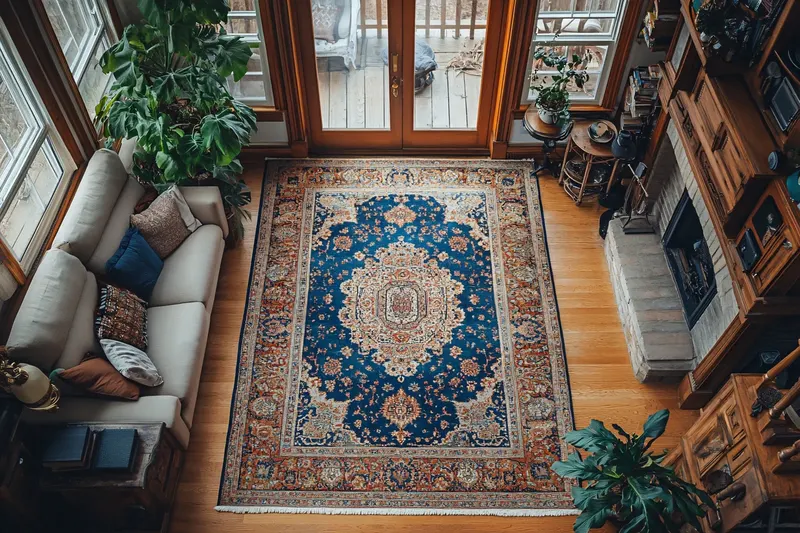
Measure the two sides in feet and multiply them together. The answer is your square footage, and rugs start at $1 a square foot, with most landing between $1 and $2, so you can work out roughly where yours will land. No fiber changes the rate, only the handling, and the technician talks you through that at the door before anything is moved or unrolled.
| Rug | Square feet | Starting at |
|---|---|---|
| 2x8 hall runner | 16 | from $16 |
| 4x6 bedside | 24 | from $24 |
| 7x10 living room | 70 | from $70 |
| 10x14 great room | 140 | from $140 |
| 12x15 dining | 180 | from $180 |
Every visit starts at $99, which is where one small rug on its own lands; a large rug, a few rugs together, or a rug added to a carpet visit clears that by itself. Every rug is cleaned indoors, flat, where you keep it, and the figure goes to you in writing before anybody starts. It is back down where it lives the same afternoon.
If you would rather just ask, call 423-284-0493. Or send the two measurements to 423-284-0493 and you will get a number back. The full detail sits on our rug cleaning page, and our method comparison explains why we put so little water into a rug in the first place.
Questions rug owners send us
How do I tell a silk rug from a rayon one at home?
Go by how it behaves, not by how it shines. Silk is a protein fiber: it warms after a few seconds in your hand and the sheen shifts as you move your head past it. Viscose rayon, sold as art silk or bamboo silk, stays cool, and a few drops of water on a hidden corner often leave it stiff and faintly yellow once dry. If you are not certain, text a photo of the back to 423-284-0493 before you put anything on it.
Why do moths start under the sofa instead of out in the open?
Because the larvae need to be left alone. They feed on wool and silk, and they pick the parts of a rug nobody walks on, vacuums or lights: under the sofa, under a chest, the far edge behind a door. Moving the furniture and vacuuming what was beneath it twice a year breaks the cycle better than any spray. Look for bare foundation showing through in patches and fine grains that look like sand caught down in the pile.
Which way should a rug be turned when I rotate it?
End for end, a half turn, twice a year. The idea is to swap the end facing the window with the end facing the room, so sun fade and foot traffic get shared across the whole rug. Leave it a decade and both land on the same third of it. Sliding it sideways achieves nothing. Put it on the calendar beside the smoke-alarm batteries or it will not get done.
What should I put on a spill before anybody gets there?
Plain cool water, and very little of it. Lift the solids with a spoon, stand a folded towel on the spot and lean on it to pull the liquid up, then dab a small amount of cool water and press again. Keep supermarket spot sprays off wool and silk, because several of them are alkaline enough to move the dye and leave a ring worse than the spill. If it is red wine or a pet accident, stop after the pressing and call us.
Is a rug pad worth buying, or is it just an upsell?
Worth it, and mostly for reasons that have nothing to do with comfort. The pad keeps the rug from wandering and buckling, it cushions the footstep so trapped grit does less cutting, and it holds the backing off your floor with a gap air can travel through. Pick felt with a light rubber grip rather than one solid rubber sheet, which seals damp against the floor.
Does an area rug need doing as often as the carpet under it?
Usually more often, because a rug takes concentrated traffic on a small footprint. For most houses around here that is once a year, and every six to nine months where there are dogs, small children, or a door the rug sits just inside of. Rugs collect grit wherever they lie, and grit cuts, so the interval is really about abrasion rather than how dirty the rug looks.
Can a vacuum get grit out of a rug on its own?
Not all of it. A vacuum pulls what sits in the top third of the pile, and sharp grit works its way down to the base where suction cannot reach it. Slow weekly passes with the brush switched off, plus a pass across the back of the rug a few times a year, gets most of what is reachable. The rest takes a long dry pass and then a low-moisture clean, done on the floor the rug already lives on.
Back on your floor before lunch is over.
Low-moisture deep clean, dry in about an hour · Love the clean or it's free.